Understanding Intelligence
There is no official definition of intelligence; indeed, the concept of intelligence is completely superfluous. Below we look at definitions from main "reliable" sources available today:
Dictionary Definition
"Set of mental faculties having as their object conceptual and rational knowledge. Ability of a human being to adapt to a situation, to choose means of action according to the circumstances."
Wikipedia Definition
"Intelligence is the set of processes found in systems, more or less complex, living or not, which allow us to learn, understand or adapt to new situations."
ChatGPT Definition
"Intelligence is a complex and multidimensional concept that does not have a single, universally accepted definition, but it can be described from several perspectives."
Plato's Definition
"Intelligence is 'The activity that allows one to acquire knowledge.'"
In, short, as you may have noticed, it’s impossible to have a clear and precise definition of Intelligence that everyone agrees on because the concept is simply indefinable!
Test-Your-Intelligence.com offers you the opportunity to measure your intelligence through 11 tests covering essential knowledge areas:
ART
Welcome to our ART exam for higher education students. In this subject, students will learn all the essential aspects of art throughout the centuries.
All questions are multiple choice questions with four possible answers, each with an illustration and detailed explanation of the correct answer for better understanding.
The students can learn and practice as much as they like before registering for the official exam, which takes place once a month.
These courses are structured according to six categories, balancing historical periods, contemporary themes, and specific art genres. Here are the six categories offered:
1. Art Historical Periods
This category explores significant art historical periods, including the Renaissance, Baroque, and Romanticism, highlighting key movements, styles, and influential artists. Students will learn about the evolution of artistic techniques, themes, and societal influences that shaped these periods. Each question focuses on iconic artworks and their context, encouraging a deeper understanding of art's historical significance.
2. 19th Century Art Movements
In this category, students will delve into the various art movements of the 19th century, such as Realism, Impressionism, and Post-Impressionism. Through the examination of renowned artists and their masterpieces, students will gain insight into how these movements reflected social changes, individual emotions, and the shifting perspectives on nature and society. The questions will help them recognize the distinct characteristics of each movement
3. Modern Art
This section introduces students to Modern Art, emphasizing the innovations and radical changes that emerged in the late 19th and early 20th centuries. Movements like Cubism, Futurism, and Abstract Expressionism are explored through the works of influential artists such as Pablo Picasso, Wassily Kandinsky, and Jackson Pollock. Students will understand how these movements challenged traditional artistic conventions and embraced new forms of expression.
4. Contemporary Art
Students will explore the diverse landscape of Contemporary Art, examining the works of artists who respond to current social, political, and cultural issues. This category highlights movements such as Pop Art, Feminist Art, and Environmental Art, encouraging students to engage with themes of identity, consumerism, and technology. The questions will provide a comprehensive overview of how contemporary artists utilize innovative mediums to convey their messages.
5. Art and Technology
This category focuses on the intersection of art and technology, exploring how digital media, interactive installations, and new technologies influence contemporary artistic practices. Students will learn about the significance of digital art, virtual reality, and generative art, as well as how artists like Olafur Eliasson and Yayoi Kusama utilize technology to create immersive experiences. The questions will highlight the evolving relationship between art and technology.
6. Art and Society
In this final category, students will examine the role of art in society, particularly how it reflects, critiques, and engages with social issues. This includes exploring themes of identity, race, gender, and environmental concerns through the lens of contemporary artists. The questions will encourage students to think critically about the power of art to provoke thought and inspire change, emphasizing its relevance in today's world.
Prepare yourself for an insightful journey through these topics, which are essential for understanding the complex interactions that shape our world today.
BUSINESS
Welcome to our BUSINESS exam for higher education students. In this subject, students will learn all the key business-related aspects of today's modern companies.
All questions are multiple choice questions with four possible answers, each with a detailed explanation of the correct answer for better understanding. The students can learn and practice as much as they like before registering for the official exam, which takes place once a month.
These courses aim to assess your knowledge according to six detailed categories, each contributing to a deeper understanding of the interactions between businesses and the world. These six categories are:
1. Business Strategy and Management
Students will need to solve problems related to managing a business, strategic decision-making, competitive analysis, and setting long-term goals.
2. Finance and Accounting
Questions will focus on financial decisions, cash flow management, reading and interpreting financial statements, and investment analysis.
3. Marketing and Sales
This theme covers marketing strategies, positioning, market segmentation, sales management, and the use of digital tools.
4. Human Resources (HR) and Organizational Behavior
Problems here will revolve around personnel management, team motivation, conflict resolution, talent management, and performance evaluation.
5. Operations and Supply Chain Management
This theme will address managing the daily operations of a business, supply chain management, and operational efficiency.
6. Business Ethics and Corporate Social Responsibility (CSR)
Questions in this theme will focus on starting businesses, innovation, entrepreneurial risk management, and seeking funding for startups.
Prepare yourself for an insightful journey through these topics, which are essential for understanding the complex interactions that shape our world today.
ECONOMY
Welcome to our ECONOMICS exam for higher education students. In this subject, students will learn all the key aspects of economies around the world and also learn the theories of the greatest recognized economists.
All questions are multiple-choice questions with four possible answers, each accompanied by a detailed explanation of the correct answer for better understanding. Students can learn and practice as much as they like before registering for the official exam, which takes place once a month.
These courses aim to assess your knowledge according to six detailed categories, each contributing to an understanding of the current global economy. These six categories are:
1. Microeconomics
Microeconomics is a branch of economics that studies the behavior of individual economic agents, like households and firms, and how they interact in markets. It focuses on concepts like supply, demand, and market equilibrium to understand how prices and quantities of goods and services are determined.
2. Macroeconomics
Macroeconomics is the study of the overall economy, focusing on factors like economic growth, inflation, and unemployment, and how they interact within a national or global context. It analyzes the big picture, looking at things like total national income, price levels, and the business cycle.
3. Economic Theories
Economic theories are frameworks that explain how economies function. Classical economics, for example, emphasizes free markets and self-regulation, while Keynesian economics focuses on the role of government intervention to manage aggregate demand and stabilize the economy.
4. Economic Policy
Economic policy covers a wide range of measures which governments use to manage their economy. These include monetary policy (money supply and demand), taxation, budget, job creation, etc.
5. International Trade and Globalization
International trade and globalization are closely related concepts, with globalization often described as the process that facilitates and expands international trade. International trade is the exchange of goods and services between different countries, while globalization is the broader process of increased interconnectedness and interdependence among countries, encompassing not just trade but also flows of capital, information, and people.
6. Market Structures
Market structure refers to the characteristics of a market that influence the behavior of firms and their interactions with buyers. The main types of market structures are perfect competition, monopoly, oligopoly, and monopolistic competition. These structures are defined by factors like the number and size of firms, the nature of the products, barriers to entry, and the degree of competition.
Prepare yourself for an insightful journey through these topics, which are essential for understanding the complex interactions that shape our world today.
GEOGRAPHY
Welcome to our GEOGRAPHY exam for higher education students. In this subject, students will learn all the main aspects of world geography, population studies, and climate analysis.
All questions are multiple choice questions with four possible answers, each with an illustration and detailed explanation of the correct answer for better understanding. The students can learn and practice as much as they like before registering for the official exam, which takes place once a month.
These courses aim to assess your knowledge in six detailed categories, each contributing to a deeper understanding of the interactions between geography, demography, and environmental systems on a global scale. These six categories are:
1. Physical Geography and Oceans
This section covers the fundamental features of the Earth's surface, including major landforms, bodies of water, and the significant role of ocean currents in influencing global weather patterns.
2. World Demographics
You will explore questions related to the population distribution, growth rates, and demographic trends across different countries, analyzing how these factors shape societies and economies.
3. World Population Studies
This category tests your knowledge of the capitals of major countries, enhancing your understanding of global geopolitics and cultural geography.
4. Climates and Global Climate Zones
Dive into the study of various climate types such as continental, monsoon, polar, and more, examining how climate zones impact human activity, ecosystems, and regional characteristics.
5. Urban Dynamics and Population Distribution
Analyze urbanization patterns and the spatial distribution of populations, looking at the contrasts between urban and rural areas and their socio-economic implications.
6. Ecology and Marine Currents Influence
Investigate how marine currents affect climate systems, biodiversity, and human activities like fishing and maritime trade.
Prepare yourself for an insightful journey through these topics, which are essential for understanding the complex interactions that shape our world today.
GEOPOLITICS
Welcome to our GEOPOLITICS exam for higher education students. In this subject, students will learn the main aspects of contemporary global geopolitics.
All questions are multiple-choice questions with four possible answers, each accompanied by an illustration and a detailed explanation of the correct answer for better understanding. Students can learn and practice as much as they like before registering for the official exam, which takes place once a month.
These courses aim to assess your knowledge according to six detailed categories, each contributing to a deeper understanding of the geopolitical interactions between different countries and world powers like USA, China and Russia. These six categories are:
1. Conflicts and International Relations in 2024
This theme will cover the main current international conflicts, their causes, and their global impacts. Relations between major powers such as the United States, China, Russia, and the European Union will also be addressed. Students will need to understand the complex dynamics of alliances, economic rivalries, as well as the role of international organizations such as the UN or NATO.
2. Climate Change and Environmental Geopolitics
In 2024, climate change has become a key factor in geopolitical decisions. This theme will explore how natural disasters, climate migrations, and environmental policies influence relations between countries. Topics such as the Paris Agreement, conflicts over natural resources, and sustainable development strategies will be included.
3. Technology, Cybersecurity, and Digital Geopolitics
The rise of information technologies and cybersecurity is a major geopolitical issue. This theme will cover state-level cyberattacks, the question of digital sovereignty, and the influence of tech giants on international policies. It will also examine how new technologies, such as artificial intelligence and 5G, are shifting the global balance of power.
4. Global Economy and Trade Relations
The global economy is another fundamental pillar of geopolitics. This theme will address international trade relations, economic sanctions, regional economic blocs (such as the European Union, NAFTA, or ASEAN), and trade conflicts such as those between the United States and China. Students will also learn about the impact of economic crises on international relations.
5. Migration and Human Rights in Geopolitics
This theme will cover issues related to international migration, refugee crises, and the immigration policies of various countries. The geopolitical issues surrounding human rights will also be addressed, particularly how humanitarian crises influence foreign policy and diplomacy.
6. Geopolitics of Natural and Energy Resources
Access to natural resources, such as oil, water, and minerals, is a hot topic in geopolitics. This theme will address resource-related conflicts, the energy transition towards renewable energy, and the role that major powers play in securing strategic resources. Students will also explore the relationships between resource-producing and resource-consuming countries.
Prepare yourself for an insightful journey through these topics, which are essential for understanding the complex interactions that shape our world today.
GRAMMAR & SPELLING
Welcome to our GRAMMAR & SPELLING exam for higher education students. In this subject, students will demonstrate their ability to write correctly without making grammatical or spelling errors.
In this exam, students will practice writing correctly using dictations from all of Aesop's fables, such as "The Tortoise and the Hare," "The Fox and the Grapes," or "The Boy Who Cried Wolf." Students can learn and practice as much as they like before registering for the official exam, which takes place once a month.
These lessons aim to ensure that our students know how to write correctly, and we do so here with Aesop, who will rediscover to us all his mythical fables, which teach us the main values of life.
HISTORY, SCIENCE & INNOVATION
Welcome to our HISTORY, SCIENCE, and INNOVATION exam for higher education students. In this subject, students will cover the main aspects of these themes through recent centuries.
All questions are multiple-choice with four possible answers, each accompanied by an illustration and a detailed explanation of the correct answer for better understanding. Students can learn and practice as much as they like before registering for the official exam, which takes place once a month.
These courses aim to assess your knowledge according to seven detailed categories that explore crucial aspects of history, ancient civilizations, and scientific discoveries. These seven categories are:
Category 1: Civilizations Through Time - The Rise and Fall of Civilizations
This category explores the major civilizations that shaped history, such as the Maya, Inca, Roman Empire, and others. Students will learn about key dates, the rise and decline of these civilizations, and their cultural and technological contributions. Topics like the Mesopotamian Civilization, the Indus Valley Civilization, and Ancient Egypt will also be covered.
Category 2: The History of Religions - Religions and Beliefs: Their Origins and Evolution
This section examines the world’s major religions, including Christianity, Islam, Buddhism, and Protestantism. Students will explore their origins, key figures, and their impact on societies through the centuries. Topics like the Protestant Reformation and lesser-known religions such as Zoroastrianism and Shinto will also be included.
Category 3: The Formation of Nations - Nation-Building and Global Conflicts
This category focuses on significant events that shaped modern nations. Topics include the discovery of America, wars of independence, the two World Wars, decolonization, and the construction of the European Union. Emphasis will be placed on the causes, consequences, and key players in these events.
Category 4: Political Systems and Societies - Governance and Society: The Evolution of Political Systems
This category examines the development of various political systems throughout history, such as monarchy, democracy, dictatorships, and participatory democracies (like in Switzerland). Students will learn how these systems evolved and influenced society, with topics including constitutional law, political revolutions, and modern movements.
Category 5: Technological Innovations in History - The History of Technology: From Fire to the Future
This section explores the transformative inventions that shaped the world, such as the wheel, the printing press, electricity, the Internet, and space exploration. Students will analyze the societal impact of these innovations and how they accelerated human progress and changed ways of life.
Category 6: Major Scientific Discoveries - Scientific Breakthroughs: A Journey Through Discovery
This category covers the key scientific discoveries and theories that transformed our understanding of the world, including gravity, relativity, the Big Bang, and the solar system. Progress in medicine, such as vaccination and germ theory, as well as early scientific tools like the telescope, will also be discussed.
Category 7: Trade and Economy Through the Ages - Trade Routes and Economic Revolutions
This new category focuses on the central role of trade and economy in global history. Topics include the Silk Road, triangular trade, the Industrial Revolution, and globalization. Students will explore how trade networks and economic revolutions shaped international relations and societies.
Prepare yourself for an insightful journey through these topics, which are essential for understanding the complex interactions that shape our world today.
LITERATURE
Welcome to our LITERATURE exam for higher education students. In this subject, students will learn all the essential aspects of literature throughout the centuries.
All questions are multiple choice questions with four possible answers, each with an illustration and detailed explanation of the correct answer for better understanding. The students can learn and practice as much as they like before registering for the official exam, which takes place once a month.
These courses are structured according to six categories, balancing historical periods, contemporary themes, and specific literary genres. Here are the six categories offered:
1. Classical European Literature (Middle Ages to 18th Century)
This category explores the foundational works of European literature from ancient Greece and Rome through the Middle Ages and the Renaissance. Key figures include Homer, whose Iliad and Odyssey are cornerstones of Western epic poetry, and Virgil, whose Aeneid shaped Roman ideals of heroism and duty. Works by Dante Alighieri (The Divine Comedy) and Geoffrey Chaucer (The Canterbury Tales) represent the transition to more personal, allegorical, and socially reflective literature in the Middle Ages. Renaissance literature, such as works by William Shakespeare, shifts the focus to humanism, exploring themes of love, power, and existential questions.
2. 19th Century Literature
The 19th century marked a period of immense social, political, and industrial change, and literature of this era reflects these transformations. This category covers the Romantic movement, with authors like Mary Shelley (Frankenstein) and poets like Lord Byron, who emphasized emotion, nature, and individualism. Realism and Naturalism follow, with novelists like Charles Dickens (Great Expectations) and Leo Tolstoy (War and Peace), who portray society's struggles, highlighting issues of class, poverty, and moral dilemmas.
3. Contemporary Literature (20th Century to Present)
This category includes works written from the mid-20th century to the present, focusing on diverse voices and global perspectives. Themes such as identity, memory, and cultural conflict are prevalent in works like Beloved by Toni Morrison, which explores the legacy of slavery, and One Hundred Years of Solitude by Gabriel García Márquez, which popularized magical realism. Postcolonial literature is also significant, with authors like Salman Rushdie (Midnight’s Children) addressing the effects of imperialism and the complexities of national identity.
4. American Literature
American literature reflects the nation's diverse history, from early colonial writings to modern explorations of identity and power. Key works in this category include foundational texts like The Scarlet Letter by Nathaniel Hawthorne, which addresses themes of sin and morality, and The Great Gatsby by F. Scott Fitzgerald, which critiques the American Dream. The category also explores African American literature, such as Invisible Man by Ralph Ellison, which delves into race and invisibility in American society.
5. Poetry and Drama
This category focuses on poetic and dramatic works, from the classical tragedies of Sophocles (Oedipus Rex) to the modernist experiments of T.S. Eliot (The Waste Land). Shakespeare’s plays are central, with their timeless exploration of human nature, while more contemporary plays like Death of a Salesman by Arthur Miller critique the failures of the American Dream. Poetry from different eras, including the Romantic verses of John Keats and the existential works of Dylan Thomas, is also studied for its emotional power and stylistic innovations.
6. World Literature and Translations
Modernist and Postmodernist literature challenges traditional narrative forms and explores themes of alienation, identity, and fragmentation in the 20th and 21st centuries. Key figures include James Joyce, whose Ulysses uses stream-of-consciousness to depict the inner workings of the mind, and Franz Kafka, whose The Trial presents a surreal, bureaucratic nightmare. Postmodern authors like Thomas Pynchon (Gravity’s Rainbow) and Don DeLillo (White Noise) experiment with narrative structure and critique the effects of technology and consumerism.
Prepare yourself for an insightful journey through these topics, which are essential for understanding the complex interactions that shape our world today.
MATHEMATICS
Welcome to our MATHEMATICS exam for higher education students. In this subject, students will demonstrate their ability to solve mathematical formulas including addition, subtraction, and division.
All questions are multiple-choice questions with four possible answers. Students can learn and practice as much as they like before registering for the official exam, which takes place once a month.
These courses aim to assess your knowledge of simplified mathematics so that we can be sure you know how to calculate the basics of mathematics.
PHILOSOPHY
Welcome to our PHILOSOPHY exam for higher education students. In this subject, students will learn all the essential aspects of Philosophy throughout the centuries.
All questions are multiple choice questions with four possible answers, each with an illustration and detailed explanation of the correct answer for better understanding. The students can learn and practice as much as they like before registering for the official exam, which takes place once a month.
These courses are structured into six categories, balancing historical periods, contemporary themes, and specific philosophical genres. The six categories offered are:
1. Ancient Philosophy
This category will cover the foundational thinkers and ideas of ancient Greek and Roman philosophy, such as Socrates, Plato, Aristotle, the Stoics, and the Epicureans. It will also include key concepts like metaphysics, ethics, and the nature of knowledge.
2. Medieval and Renaissance Philosophy
This section will explore the philosophical developments during the Middle Ages and Renaissance, focusing on figures like Saint Augustine, Thomas Aquinas, and later thinkers such as Machiavelli. Themes of theology, the nature of the soul, and political philosophy will be included.
3. Early Modern Philosophy
This category will focus on key philosophers of the Enlightenment and the scientific revolution, including Descartes, Locke, Spinoza, Hume, and Kant. Key themes will include rationalism, empiricism, skepticism, and the nature of reason and reality.
4. 19th Century Philosophy
This section will cover influential 19th-century thinkers such as Hegel, Schopenhauer, Marx, Nietzsche, and Mill. Topics like dialectics, existentialism, utilitarianism, and the critique of religion and society will be explored.
5. 20th Century Philosophy
This category will focus on major philosophical movements of the 20th century, such as existentialism, phenomenology, analytic philosophy, and postmodernism. Key figures include Heidegger, Sartre, Wittgenstein, and Foucault.
6. Ethics and Political Philosophy
This section will focus on moral and political philosophy, exploring ideas of justice, freedom, rights, and the role of the state. Thinkers like Hobbes, Rousseau, Rawls, and more contemporary philosophers like Peter Singer will be included.
Prepare yourself for an insightful journey through these topics, which are essential for understanding the complex interactions that shape our world today.
FINAL EXAM
Welcome to our FINAL exam, which will allow you to obtain your OFFICIAL CERTIFICATE OF INTELLIGENCE! In this exam, students will complete a general test of 90 multiple-choice questions with four answers plus a dictation based on all previously completed exams.
Students can relearn and re-practice as many times as they like before registering for the official exam, which takes place once a month.
If they pass this final exam, they will receive their intelligence certificate, which will be automatically delivered digitally via a free app.
They will therefore be considered "Intelligent" according to the SWISS IQ ASSOCIATION education program and will have access to the elite world.
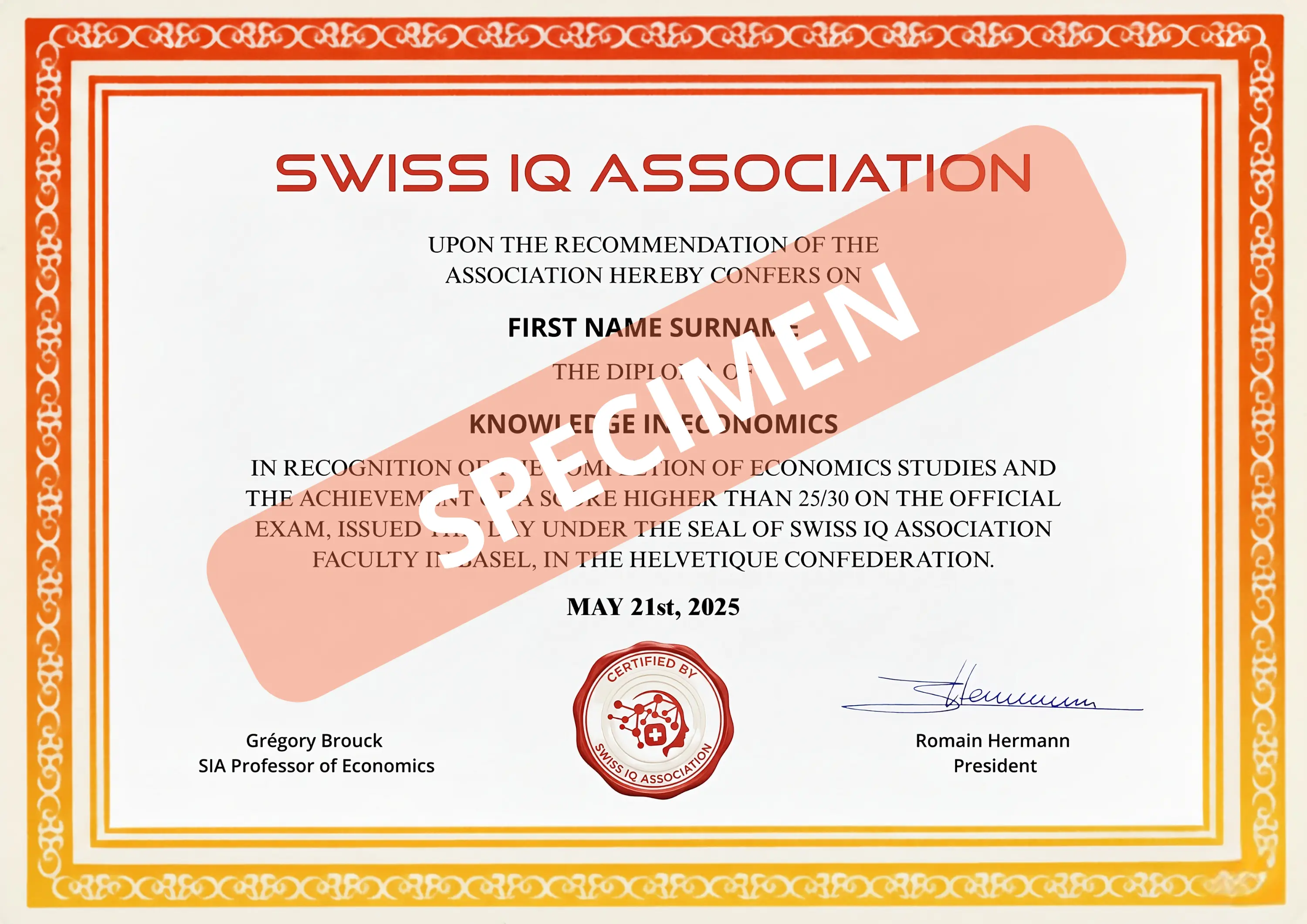
For each successful exam, students will receive their official diploma issued by the Swiss IQ Association.
These official diplomas will certify the students' proficiency in the subject in question.
These are valuable documents that should be carefully preserved.
1. Achieve Minimum IQ Score
You'll need to achieve a minimum IQ score of 120. If you don't succeed on your first attempt, you can try again until you do. Once you've passed this step, you'll receive your official IQ certificate validated by the Swiss IQ Association, and you'll then have access to the educational program that covers all the topics listed above and you will have access to our Smartphone Application for free!
2. Choose Topic & Practice
You can choose your topic, and once validated, you can practice using our training modules on our website or app. As soon as you feel ready, you can register for the exam in question. Please note that there is only one exam per month per topic for the entire country. Everyone will take the exam at the same time under strict exam conditions (see the All the Exams tab).
3. Pass the selected Exam
If you have passed the current exam, you will then have the opportunity to select the next exam from the list of exams to take and you will receive your official certificate of achievement. If you have not passed the current exam, you will be able to re-train and re-register when you are ready to try again.
4. After passing all 10 exams
Once you have successfully passed all 10 exams, you will be able to register for the final exam, which randomly groups together questions and dictations from all previously taken exams, to obtain your Certificate of Intelligence.
5. Receive your Intelligence Certificate
Once you have passed the final exam, you can download the free IC (Intelligence Certificate) app, which officially certifies your receipt of the Intelligence Certificate.
Via App
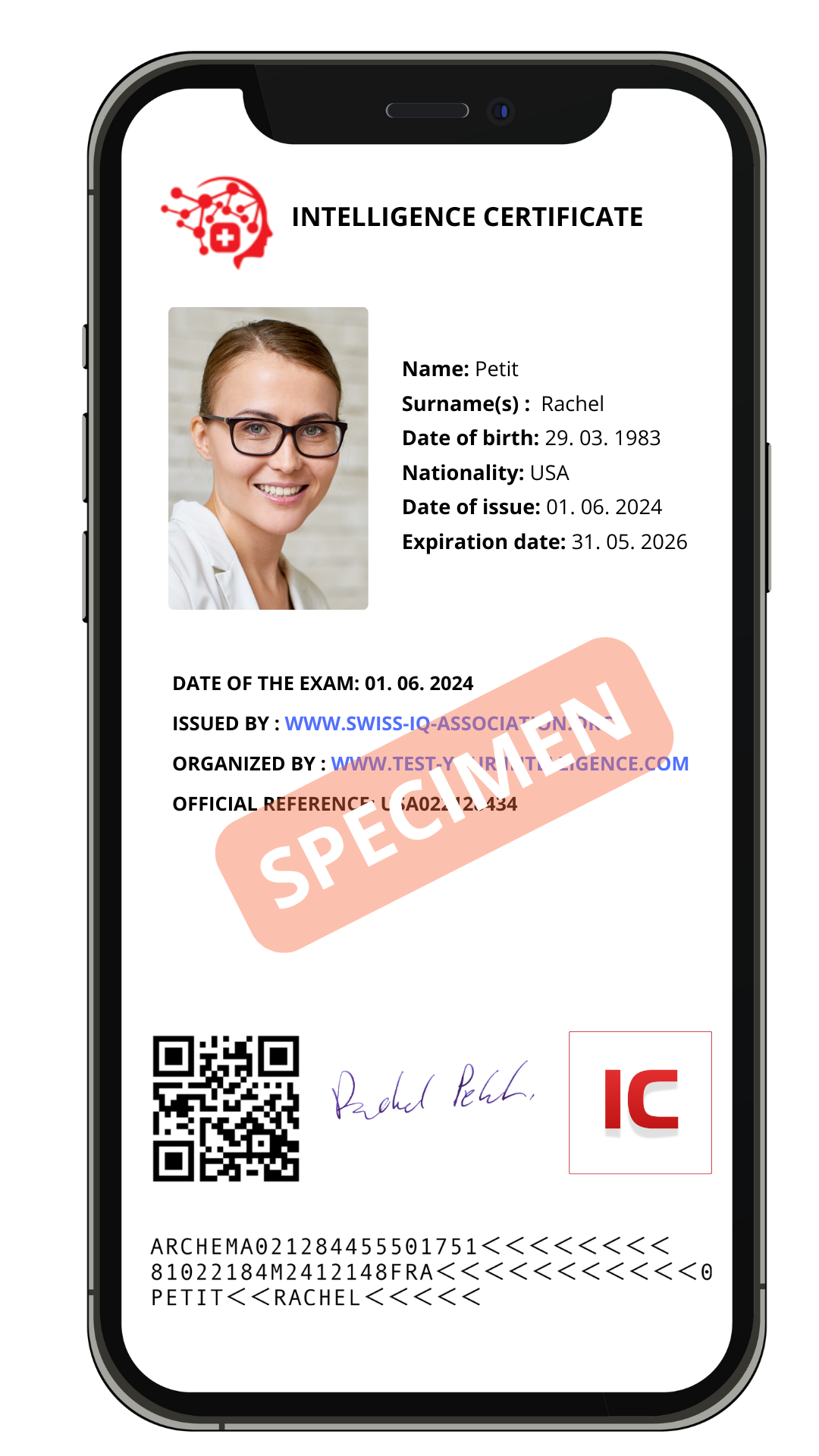
The App version looks like above and includes a QR code that allows anyone to verify its authenticity
Via physical card
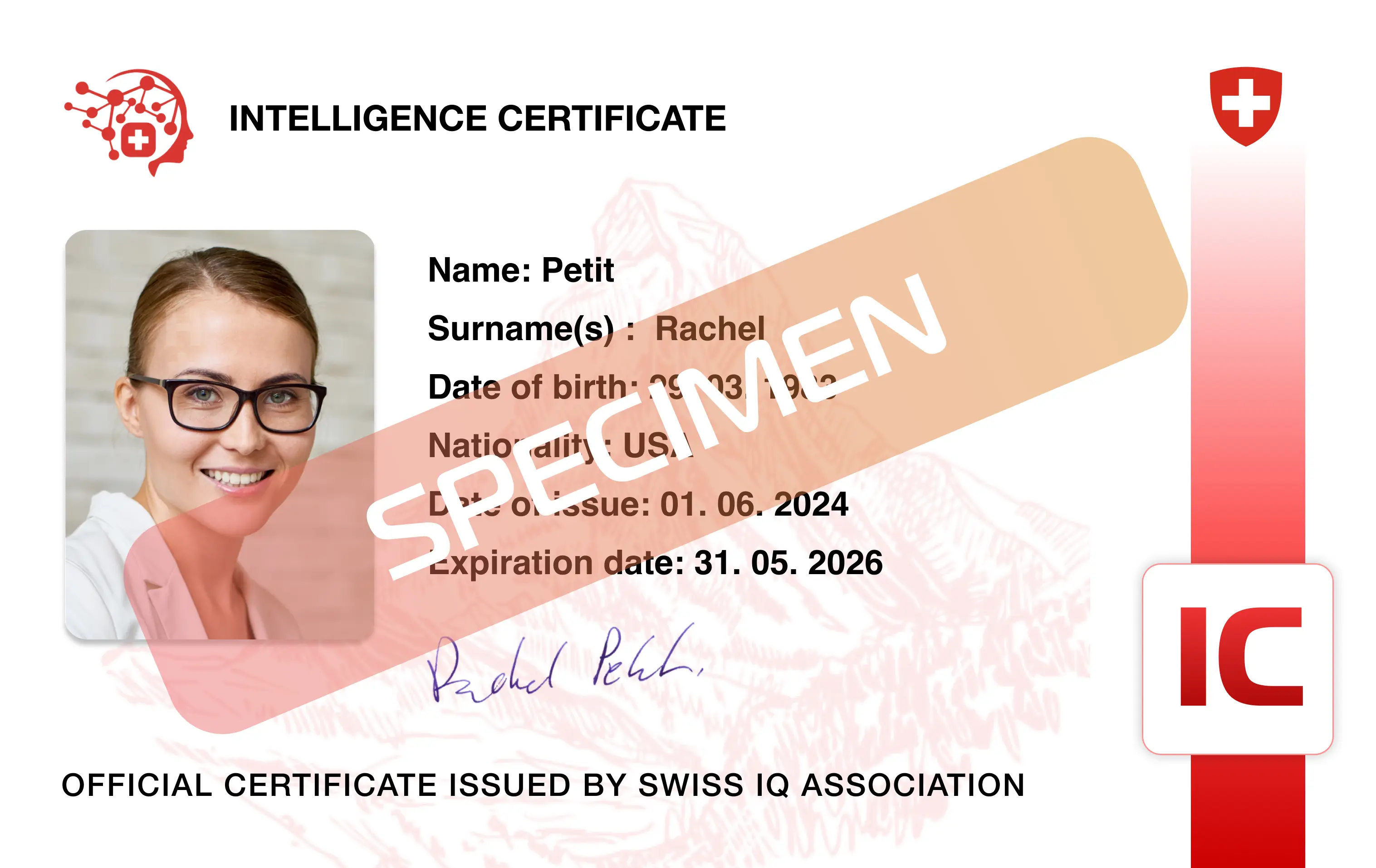
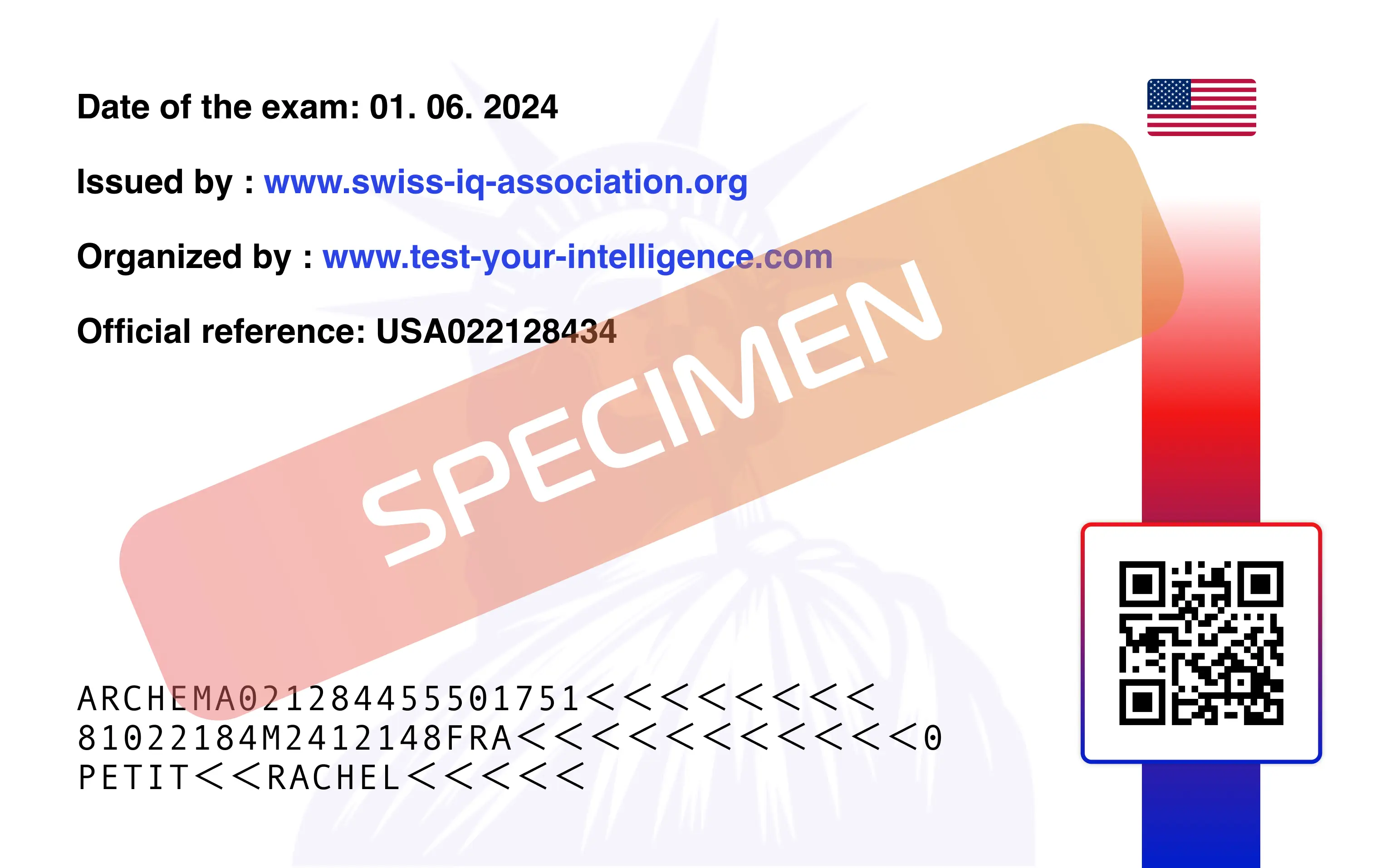
You also have the option of having your Certificate of Intelligence on a physical card (credit card format) for a cost of $75 + shipping.
